Temporary easing in trade hostilities brings modest relief to Australian markets, while critical minerals and supply-chain realignment emerge as focal points for investor optimism.
A Measured Thaw in Trade Tensions Calms Market Volatility but Leaves Strategic Frictions Intact
The May 2025 announcement of a temporary tariff truce between the United States and China has introduced a degree of calm into global markets, albeit without addressing the structural roots of the trade dispute. The agreement, which suspends certain reciprocal tariffs for 90 days, has moderated fears of a disorderly escalation and has prompted a modest rally in risk assets, including on the Australian Securities Exchange.
Yet for investors, the truce offers more symbolic reassurance than concrete resolution. The continuation of core Section 301 tariffs on sectors such as electric vehicles, semiconductors and battery inputs underscores the long-term decoupling trajectory in strategic industries. For Australia, which sits at the crossroads of Chinese commodity demand and Western supply chain diversification, the implications are both complex and consequential.
Australian Equities Respond Selectively, With Gains Concentrated in Strategic Commodities and Energy Transition Themes
While the broader ASX has reacted with relative restraint, certain pockets of the market, particularly those tied to critical minerals and export-facing industrials, have seen renewed investor interest. The modest easing of trade pressure has coincided with improved sentiment toward sectors aligned with global decarbonisation and technological resilience. In particular, lithium producers, rare earth refiners and diversified miners with exposure to non-China supply chains have emerged as key beneficiaries.
This reflects a growing conviction among market participants that Australia’s role in the post-globalisation supply map is becoming more defined. With Western economies seeking to secure non-Chinese sources of key inputs, Australian firms offering scalable, ESG-compliant production have found themselves increasingly central to long-term strategic planning, whether for electric vehicles, clean energy systems or critical infrastructure.
China’s Economic Trajectory Remains the Swing Factor for Broader ASX Resource Exposure
Notwithstanding the tailwinds for critical minerals, the broader outlook for Australian resource stocks remains tethered to Chinese macroeconomic conditions. Iron ore, coal and base metals, mainstays of ASX earnings, remain vulnerable to fluctuations in Chinese construction activity, infrastructure investment and industrial output. With the Chinese property sector still under pressure and policy support measures uneven, the near-term demand picture remains far from robust.
That fragility could weigh on earnings for diversified majors, particularly those with deep exposure to bulk commodities. Moreover, any breakdown in the current truce or renewed escalation in tariff rhetoric could again pressure market sentiment. The underlying message for investors is that while structural themes offer clarity for select sectors, the broader backdrop remains shaped by geopolitical and economic uncertainty.
Critical Minerals and Non-China Supply Chains Continue to Draw Strategic Capital and Policy Support
In contrast, the strategic pivot toward non-China supply chains appears to have a firmer foundation. The continued application of high tariffs on Chinese electric vehicles, solar technologies and lithium-ion batteries reinforces the thesis that Australia’s relevance is increasing, not diminishing. Canberra’s own efforts to support value-added processing, coupled with international demand for reliable partners, have added depth to the investment case for Australia’s upstream and midstream critical minerals segment.
We are already witnessing this in capital markets, with sustained equity issuance and M&A activity across lithium, rare earths and downstream processing projects. Policy momentum—domestically and among allies such as the US, EU and Japan—suggests that the decoupling trend will outlast the current truce, offering a measure of insulation from short-term market volatility for well-positioned firms.
Cautious Optimism Prevails, But Market Still Awaits Durable Resolution Beyond the Current 90-Day Pause
Taken together, the US-China tariff reprieve offers a modest but welcome stabilising effect on Australian equities. While the benefits are unevenly distributed, sectors linked to strategic realignment and the green transition are seeing renewed attention. Still, investors remain aware that the détente is temporary and that the structural undercurrents driving decoupling are far from resolved. Much will depend on subsequent negotiations, the trajectory of Chinese domestic demand, and the willingness of major economies to balance competition with cooperation.
Now, let’s take a look at three ASX-listed stocks that could rebound, benefitting from the recent developments in the US-China trade environment…
Lynas Rare Earths (ASX: LYC)
Source: LYC, weekly chart (2025)
We see Lynas as a potential contrarian play, thanks to a combination of strategic moves and solid operational performance.
As the largest producer of separated rare earth oxides (NdPr) outside China, Lynas is in a great position to benefit from the growing global effort to diversify rare earth supply chains. With more countries, especially in North America and Europe, looking to secure non-Chinese sources for key materials in electric vehicles, wind turbines, and defence, Lynas is poised to play a bigger role.
Looking at the recent numbers, Lynas is holding its own. For Q3 FY25, the company reported a rise in quarterly revenue to $123.0 million and managed to improve its average selling price despite the market’s challenges. Their production of 1,509 tonnes of NdPr shows they’re on track toward reaching their Lynas 2025 target of 10.5kt per year in NdPr production.
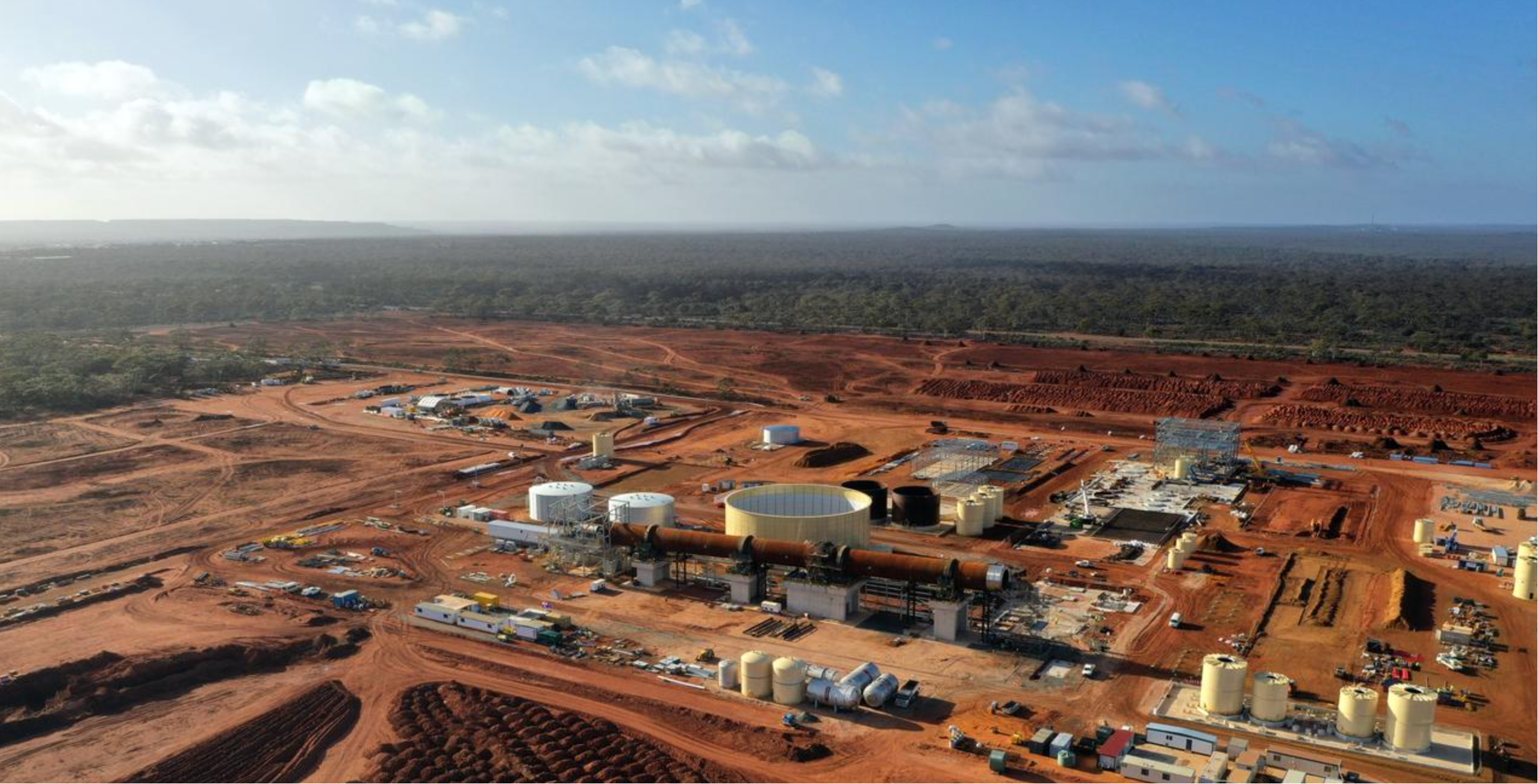
One of the big things we’re watching is the Kalgoorlie Heavy Rare Earth separation facility. This is a major step for Lynas, as it will allow them to produce Dysprosium and Terbium, both critical for high-performance magnets used in EVs and defence systems. We’re expecting Dysprosium production to kick off in May 2025, with Terbium to follow in June.
Also, with plans for a U.S.-based processing facility in the works, Lynas is positioning itself as a key player for American strategic needs, ensuring long-term demand.
With all these developments coming together, we believe Lynas is a solid long-term buy with plenty of growth potential.
Pilbara Minerals (ASX: PLS)
Source: PLS, weekly chart (2025)
We believe Pilbara Minerals (ASX: PLS) could present a compelling rebound opportunity, particularly considering recent developments in U.S.-China trade relations. As a leading pure-play lithium producer operating the Pilgangoora project in Western Australia, Pilbara sits at the centre of a critical supply chain supporting the global transition to electric vehicles and clean energy.
What makes Pilbara stand out right now is the growing strategic focus on diversifying lithium supply away from China. With the U.S. and its allies prioritizing secure and independent supply chains, Pilbara is well positioned to benefit. Its Tier-1 asset, located in a stable jurisdiction, combined with its downstream joint venture with South Korea’s POSCO, enhances its long-term strategic value.
Admittedly, recent lithium market softness, driven largely by reduced demand and pricing pressure in China—has impacted financial results. Revenue declined, and the company reported a statutory loss in the first half of FY25. However, operational performance remains strong. Pilbara achieved record production of 408.3kt of spodumene concentrate, up 28% on the prior year. The P1000 expansion, which achieved first ore in January 2025, is expected to lift volumes and reduce unit costs once fully ramped in FY26.
The company’s $1.2 billion cash position provides a solid financial cushion, and management is taking a disciplined approach to investment in the current market environment, a prudent strategy, in our view.
That said, while near-term challenges persist, Pilbara remains fundamentally strong and strategically relevant. As global efforts to secure non-Chinese lithium supply intensify, we see Pilbara as well placed to benefit. We maintain our view that this is a long-term buy.
Mineral Resources (ASX: MIN)
Source: MIN, weekly chart (2025)
We think Mineral Resources (MinRes) could be well-placed to benefit from the recent shifts in China/US trade dynamics. As global supply chains for critical minerals start to realign, MinRes stands out as a diversified Australian producer with strong exposure to both lithium and iron ore.
There’s a bigger picture here. China is increasingly focused on securing long-term access to essential resources like lithium and iron ore, especially amid geopolitical uncertainty. At the same time, the U.S. and its allies are actively looking to reduce reliance on Chinese-dominated supply chains. That puts companies like MinRes—operating in a stable, resource-rich jurisdiction—at the center of this transition.
MinRes brings scale through its Wodgina and Mt Marion lithium operations, while its iron ore business is expanding thanks to the ramp-up of the Onslow Iron project, which shipped 3.6 million tonnes in Q3 FY25. The recent uplift in spodumene volume guidance for Mt Marion shows positive momentum on the lithium front, even as Wodgina volumes remain steady.
We see a few potential catalysts. Lithium prices have been under pressure, but with EV demand expected to recover and signs of Chinese restocking, there’s scope for a bounce. Meanwhile, iron ore remains vital for China’s infrastructure and housing stimulus, and MinRes is well-placed to meet that demand with competitive supply. On top of that, Western governments are increasingly looking to secure ESG-compliant sources of critical minerals, which could open new opportunities for MinRes over time.
Yes, there are some watchpoints. Onslow’s costs are tracking toward the higher end of guidance, and net debt sits at A$5.4 billion. But the company has flagged confidence in its ability to refinance its 2027 bond, and it continues to execute on long-term growth plans across its core divisions.
All up, MinRes has the right mix of assets and exposure to benefit from this evolving global backdrop. If lithium sentiment improves and iron ore demand holds up, we see room for a potential strong rebound.